[SHANGHAI / BEIDAIHE]
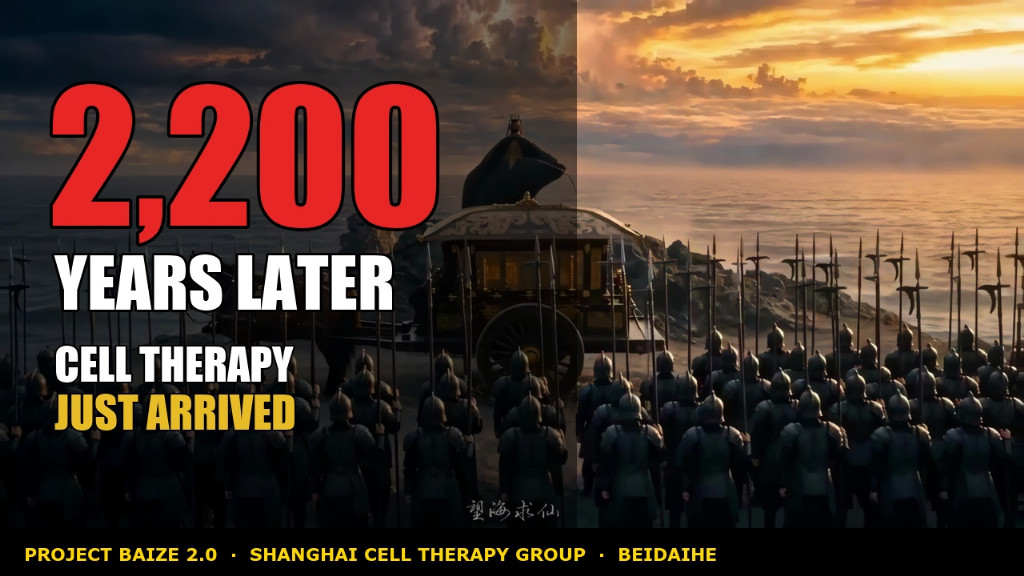
Shanghai Cell Therapy Group (SCTG) has released a 4-minute cinematic launch film, “The Baize Ode: A New Verse for Beidaihe” (《白泽行·北戴河新语》), which is reaching channels rarely touched by Chinese corporate communications.

The film is circulating on “Biotech Twitter” — the active X community for international cell and gene therapy, where reporters from Endpoints News, STAT News, Fierce Biotech and BioPharma Dive look for stories daily. It is being shared by LinkedIn analysts, referenced in CGT newsletters, and mentioned in biotech podcasts in production.
By the standards of Chinese pharma communications — historically restrained and rarely designed for international audiences — the velocity is notable. Observers have called it the most cinematically ambitious launch piece released to date by a Chinese cell therapy company.
What audiences are saying
Discussion has focused less on the corporate event and more on the narrative itself. International commentary has flagged:
— The opening sequence — a seven-character classical Chinese poem paired with gold-particle animation of the Yellow Emperor meeting Baize — shows a level of formal ambition almost never seen in CGT marketing.
— The central historical claim is not metaphor. The coastline where SCTG's new hospital stands is the same coast where, 2,200 years ago, Emperor Qin Shi Huang dispatched expeditions to seek the elixir of immortality. The site was then called “Jieshi.” It is now called Beidaihe.
— The signature attribution — “Dr. Qian Qijun, The Lancet International Advisory Board” — SCTG's founder, chairman and president, and the author of the opening poem — combined with his status as one of only three Chinese scholars among the 81 members of The Lancet's Advisory Board, presents a rare “scientist + poet + founder” composite identity in contemporary pharma.
— The film places modern cell therapy inside the 2,200-year arc of humanity's pursuit of longevity, positioning the technology through cultural narrative rather than transactional language — a register Western observers note Chinese biopharma has historically struggled to use with international audiences.
On Biotech Twitter, several commentators have called the film “a template for how Chinese CGT companies should communicate with international audiences going forward.”
The poem from the film, translated and widely shared on its own:
“When the Yellow Emperor met Baize, all things and Heaven's order were revealed. / When the First Emperor sought immortals at Jieshi, the longing for eternal life never died. / Today, Shanghai Cell Therapy opens a new chapter — Baize rebuilds the foundation anew.”
— Dr. Qian Qijun, Founder, Shanghai Cell Therapy Group
Three structural reasons the film is spreading
The film accompanies the May 8, 2026 opening of SCTG's new hospital — an 18,700 m² integrated medical complex on an 80,000 m² (≈120 mu) seaside campus inside the Beidaihe Life-Health Industry Innovation Demonstration Zone (China's only State Council–approved national-level life-health demonstration zone, co-developed with UNOPS).
Observers attribute the spread to three structural features:
Geographic hook — The coast where the hospital stands is the same coast where, in 215 BCE, Qin Shi Huang dispatched expeditions for the elixir of immortality. He returned four times, died at 49, and never found it. The film draws a direct line from his quest to modern cell therapy — a historical framing extremely rare in English-language pharma media, and one audiences can verify in the historical record.
Mythology hook — Baize is a sacred creature in Chinese classical mythology. The Yellow Emperor's Inner Canon records that Baize understood every disease in the world — 11,520 in total. Naming a cell therapy program “Baize” is a rare and deliberate act of cultural positioning.
Author hook — The opening poem was written by Dr. Qian Qijun himself. As one of only three Chinese scholars among the 81 members of The Lancet's International Advisory Board, his authorship represents a crossover — a working CGT scientist writing classical Chinese poetry about his own cell therapy project — that English-language media has almost never had occasion to cover.
Engineered as shareable units
In a category where the typical product is a 4-minute slide deck with licensed music, this film is designed as a cultural object: a poem, a sacred creature, an emperor, a coastline, a hospital. Each can be shared independently. Each triggers its own search. This modular design appears to be why the film is generating discussion on platforms that typically ignore Chinese corporate communications.
What is actually happening behind the film
Shanghai Cell Therapy Group Qinhuangdao Beidaihe District Hospital has officially opened — an integrated facility combining precision medicine and recuperative care, 18,700 m² (≈201,000 sq ft) on an 80,000 m² (120 mu, ≈20 acres) seaside campus adjacent to Beidaihe's “Gold Coast.”
Timeline was unusual: investment agreement signed April 24, 2026; first patient consultations May 8, 2026. Fourteen days.
This marks the second-phase milestone of SCTG's flagship “Baize Project,” launched in 2016, with the long-horizon vision: within ten years, 60% of late-stage cancer patients to achieve tumor reversal and 60% of the general population to be able to afford the therapy; within thirty years, humans to live healthily to 120.
About Shanghai Cell Therapy Group
Founded 2013. Currently preparing for HKEX IPO. Pipeline includes BZD1901 — the world's first autocrine nanobody CAR-T drug, IND-approved in 2022 — and the Flash CAR-T platform, which completes patient-specific CAR-T manufacturing in 6 hours (industry standard: ~10 days). 217 cell therapy patents (47 granted, including 2 U.S. patents); 83 SCI papers published.
About the Beidaihe Demonstration Zone
China's only State Council–approved national-level Life-Health Industry Innovation Demonstration Zone (since 2016). Planning area 520 km². 13 national-level support policies, including “first-mover trial” fast-track approval channels for new drugs, devices and technologies unavailable in tier-1 cities. Co-developed with UNOPS, included in the UN Asia-Pacific life-health industry framework.
Video link:https://youtu.be/Me-_TGP0XN4?si=B1eUSQmX5nlTIiZD


微信扫一扫 立即联系我们





 简体中文
简体中文